Dentist Spotlight:

Protecting Your License

Dentist’s Advantage, in collaboration with CNA, has published our Dental Professional Liability Claim Report: 3rd Edition (3rd Edition Report). It includes statistical data and case scenarios from CNA closed claim files, as well as risk management recommendations designed to help dentists reduce their malpractice exposures and improve patient safety.
You may access the complete 3rd Edition Report, and additional Risk Control Spotlights, at: www.dentists-advantage.com/dentalclaimreport.
This Dental Spotlight focuses on our analysis and risk recommendations regarding one of the most significant topics in the 3rd Edition Report: Protecting Your License.
A dentist’s license is one’s livelihood, and its protection is paramount. A dentist’s practice and conduct are expected to be safe, competent, ethical, and compliant with applicable laws and rules. Each State Board of Dentistry (the “Board”) serves to protect the public by monitoring licenses and holding them accountable to professional practice requirements. When a complaint is made against a dentist to the Board, the dentist must be equipped with the knowledge and resources to adequately defend themselves. Being unprepared may represent the difference between a dentist retaining or losing their license. This Spotlight provides an overview of the Board’s role in the legal and regulatory system, describes the disciplinary process, and offers helpful recommendations on defending yourself if you were to become the subject of a licensing board complaint.
Continue reading

Understanding the Legal System

Although this Spotlight focuses on license protection matters, it is important for dentists to understand the basic premises of the types of legal actions in which they may face allegations. The basic divisions in the U.S. legal system are criminal, civil, and administrative.
A civil case may involve the filing of a lawsuit against a dentist in civil court, which may lead to a jury award for a sum of money. Civil law protects the rights of citizens and offers legal remedies. One example of a civil action would be a medical malpractice lawsuit.
A dentist may be prosecuted on criminal charges which would be filed in criminal court and could lead to fines and/or incarceration.
Administrative law governs the rules and regulations made and enforced by government agencies, such as your State Board of Dentistry. Administrative actions taken against a dentist may lead to disciplinary action or suspension/loss of license, as exemplified in this Spotlight.

The Dental Practice Act

Each state has passed laws or regulations that govern the practice of dentists, generally referred to as the Dental Practice Act. All dentists should become familiar with their relevant state Dental Practice Act. The Dental Practice Act gives your State Board of Dentistry the authority to:
  • Establish qualifications for licensure;
  • Issue licenses to qualified individuals;
  • Establish standards of practice and conduct;
  • Take disciplinary action against those who engage in misconduct; and
  • Promulgate rules to enable the Board to perform its duties.

Dental Licensure Compact

Multiple U.S. states have enacted legislation referred to as a ‘compact’. A compact enables dentists and dental hygienists licensed in any of these states to practice in any other compact state under their original license, with the intent of enabling dentist’s mobility and increasing access to dental care in underserved areas. To practice in compact states other than that of their primary licensure, a dentist must submit an application to the compact commission, which includes verification of their primary license and may require the dentist to take an additional examination. Following this, a dentist may practice in any compact state under their original license. Dentists practicing under compact privileges remain subject to the laws, scope-of-practice requirements, and disciplinary authority of the state in which care is delivered, and not the state of their original licensure.
In the United States, there are currently two distinct interstate licensure compacts for dentists and dental hygienists. The first is the Dentist and Dental Hygienist Compact (DDHC), which is an interstate agreement among participating state governments and is strongly supported by the American Dental Association and other national stakeholders. The second is the Interstate Dental and Dental Hygiene Licensure Compact sponsored by the American Association of Dental Boards (AADB), often referred to as the AADB Compact.
Both compacts are designed to enhance licensure portability for dentists and dental hygienists across state lines, but they are governed separately and are being adopted by different groups of U.S. states.

Licensee Rights During the Disciplinary Process

If you are named in a licensing board complaint, the state will not provide nor recommend an attorney; however, you have the right to retain an attorney. The state also permits you the opportunity to present evidence to defend yourself during a hearing.

The Disciplinary Process

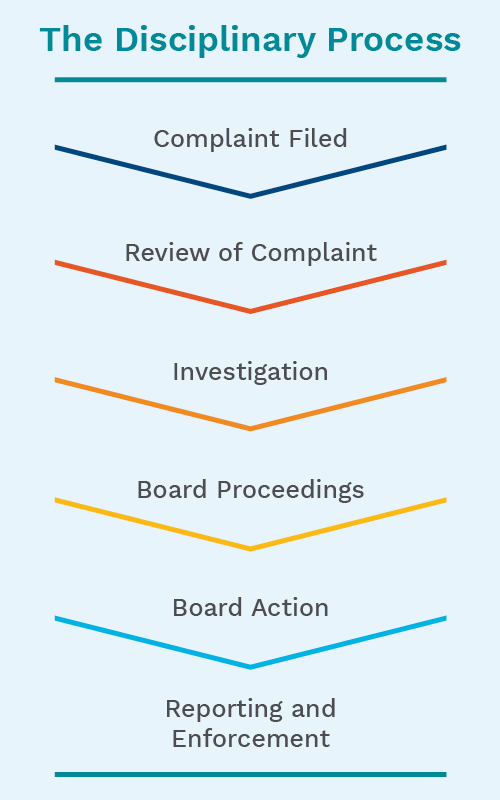
A board complaint can be filed against a dentist by anyone, such as a patient, a patient’s family member, a colleague, or an employer. You may or may not know the identity of your accuser, and the complaint can be filed anonymously. In addition, many states require self-reporting of certain violations, such as misdemeanors, felonies, and plea agreements. Involvement in a disciplinary action will take time to resolve, which can make the entire process stressful. The process is illustrated by the graphic to the right.

Investigative Stage

While the procedures may vary by state, all complaint reports are reviewed, including anonymous submissions. Many, if not all, State Boards are required to review every complaint received. However, the Board may not be permitted to tell you how it received the report or give you any information or documents, including the details or source of the complaint.
Some State Boards use board-appointed investigators who may or may not be dental professionals. The investigator will use various methods to determine the facts, such as interviewing parties who were present, reviewing documentation and records, performing drug screens (if impairment is alleged), and compiling any pertinent facts related to the events and circumstances surrounding the complaint.
You may receive a letter, email, or telephone call from the Board asking you to submit a written statement explaining your version of the events and activities involving the reported incident. Or, the Board may require you to appear for an interview with the investigator and/or members of the Board at a specific date and time. Never ignore a request from the Board.
If you are contacted during the investigative stage, consult with an attorney before you respond to the Board, ensuring to reply by the Board’s required deadline. You must be cooperative, but be aware that anything you share constitutes evidence that may be used against you by a prosecuting attorney and/or the Board.
Dentists should not appear at proceedings without legal counsel present. Consult with your legal counsel for guidance before answering questions or making statements to the Board or the investigator. Your attorney may be able to speak to the investigator, learn more about your matter, and help you navigate the process.

Board Action

Upon completion of the investigation, the prosecuting attorney or state agency will determine how to proceed. One option is an informal conference. Although less formal than hearings, informal conferences are official proceedings. Your attorney should be present with you at all proceedings. During the conference:
  • You will be interviewed by a member of the Board and possibly its attorney.
  • You will have an opportunity to present any evidence that supports your case.
  • A resolution may be offered or imposed, closing the matter.
If the Board concludes that it has significant evidence against you, the matter may proceed directly to a formal hearing where disciplinary action may be proposed. The hearing is similar to a civil trial. It may take place in a courtroom-like setting before an administrative law judge and hearing panel. The hearing panel may include several Board members, or the entire Board, depending on the state. A court reporter records the entire proceeding, creating an official transcript. During the hearing, the following will occur:
  • Information is exchanged, known as discovery, and you are entitled to review the documents possessed by the prosecutor.
  • Witnesses for and against you may be called to testify.
  • You may be questioned and cross-examined.
When both sides have presented their cases, the hearing is concluded. The outcome of the formal hearing is a ruling by the administrative law judge and the Board. The process can take months or even years to fully resolve.
The process can take months or even years to fully resolve.

License Protection vs. Professional Liability.

What’s the difference?

License Protection
Inquiry by the State Board of Dentistry arising from a complaint.
Allegation can be directly related to a dentist’s clinical responsibilities and professional services, and/or they may be of a nonclinical nature (i.e., substance abuse, unprofessional conduct or billing fraud).
The State Board of Dentistry can suspend or revoke a license. Its primary mission is to protect the public from unsafe practice of the professional.
Professional Liability
Civil lawsuit arising from a client’s malpractice claim.
Allegations are related to clinical practice and professional responsibilities.
The civil justice system cannot suspend or revoke your license to practice. Rather, professional liability lawsuits serve to fairly compensate clients who assert that they have suffered injury or damage as the result of professional negligence.

If you are contacted during the investigative stage, consult with an attorney before you respond to the Board, ensuring to reply by the Board’s required deadline.

Dental Professional Liability Spotlights

In the months ahead, please access the Dentist’s Advantage Prevention and Education Web page to download the report and Spotlights on key risk topics:

Dataset and Allegations

The 3rd Edition Report dataset includes 1,719 license protection matters attributed to an insured dentist or dental practice with claim expenses of $1 or more that closed from January 1, 2020, through December 31, 2024.

The most frequent license protection matters involve allegations of improper treatment or care, making up 59.9 percent of all alle- gations. Common examples of this allegation include improper or negligent restorative treatments or surgical techniques. These allegations incur defense costs of $4,761 per matter on average, which is slightly lower than the average expense across all allegations ($4,847). Other frequent allegations include those pertaining to professional conduct (11.1 percent), billing/ insurance/financial disputes (7.4 percent), and examination/ evaluation/diagnosis (7.3 percent), as per Figure 9.
Professional conduct allegations incur costs of $5,906 on average. Examples of these allegations include criminal misconduct or conviction, practicing with an invalid or expired license, patient abandonment, drug diversion or substance abuse, improper hiring or super- vision of employees, improper delegation of clinical tasks, and inappropriate or invasive interactions with patients.
Billing and financial disputes incur costs of $3,232 on average. Examples of these allegations include overcharging patients, charging patients for treatment not delivered, or billing insurance for treatment not delivered.
Examination/evaluation/diagnosis allegations incur costs of $7,527 on average. Examples of these allegations include failing to complete a proper patient evaluation, failing to diagnose a condition, misdiagnosing a condition, and failing to refer a patient when necessary.

9

Distribution of License Protection Matters by Top Allegations
Closed License Protection Matters with Paid Expense ≥ $1
Improper treatment/care
58.7%
59.9%
Professional conduct
7.7%
11.1%
Billing/ insurance/ financial dispute
6.5%
7.4%
Examination/ evaluation/ diagnosis
10.9%
7.3%
2020
2025

Dental Procedures

The most frequent dental procedures that result in license protection matters are those associated with dental crowns, making up 13.1 percent of all license protection matters. These incur costs of $4,661 on average, slightly less than the overall average of $4,847. These matters are typically associated with complaints of treatment failure, improper performance of a procedure, improper follow-up care, or failure to complete treatment.
The next most common procedure is clinical oral examination, making up 10.9 percent of all license protection matters. These incur costs of $5,352 on average. These matters are typically driven by failure to diagnose high-risk conditions such as oral cancer, which con- tributes to the higher incurred cost. Other allegations include failure to obtain adequate informed consent and administering unnecessary treatment.
The third most common procedure leading to board complaints is surgery involving implant placement, making up 8.3 percent of all license protection matters. These incur costs of $5,859 on average. These are typically caused by failed implants, failure to complete treat- ment, or improper performance of a procedure resulting in patient injury.

State Dental Board Outcomes

Disciplinary actions taken by State Dental Boards can range from no action against the dentist, up to and including revocation of the dentist’s license to practice. The majority of license protection matters in the 2025 dataset resulted in the Board taking no action against the dentist, at 80 percent as per Figure 10. These cases are associated with an average cost of $3,882, which is less than the average cost of $4,847 across all outcomes. 7.7 percent of cases resulted in a fine against the dentist, 4.2 percent resulted in a letter of warning or reprimand, 3.9 percent resulted in the dentist being required to undertake continuing education, and 1.9 percent resulted in the dentist being placed on probation. Finally, 0.6 percent of cases resulted in license revocation, 0.6 percent resulted in the dentist surrendering their license, and 0.6 percent resulted in suspension of the dentist’s license. License revocation is associated with the highest incurred cost on average, at $32,064, followed by license suspension ($19,758), probation ($15,185), and surrendering of one’s license ($14,485).
Based on data analyzed for the 3rd Edition Report, dental Boards often impose multiple disciplinary actions, such as issuing a reprimand coupled with a fine and continuing education requirements. For cases in which Boards took action against a licensed dentist, 51.2 percent involved secondary actions and 17.4 percent also resulted in tertiary board actions. More than three board actions against a licensee also occurred infrequently.
Depending upon the state in which you practice, most disciplinary outcomes become a permanent matter of public record. Dentists who have experienced adverse disciplinary actions may appeal those actions. The standards for appealing a Board decision are defined by your state and will outline the specific requirements, time frames, and processes.

10

Distribution of License Protection Matters by Top Allegations
Closed License Protection Matters with Paid Expense ≥ $1
Closed – no action
74.6%
80.0%
Fine
6.4%
7.7%
Letter of warning/ reprimand
5.4%
4.2%
Continuing education (CE)
6.4%
3.9%
Probation
2.4%
1.9%
Revocation
0.0%
0.6%
Surrendered license
0.6%
0.6%
Suspension
1.0%
0.6%
Other
3.2%
0.5%
2020
2025

National Practitioner Databank

The National Practitioner Databank (NPDB) is an online repository of reports on medical malpractice payments and other adverse actions related to health care practitioners, including dentists. Its aim is to prevent practitioners from moving between states without disclosure or discovery of previous damaging performance. Depending upon the state in which you practice, most outcomes involving discipline against a dentist’s license are a matter of public record and reported to the NPDB. Certain eligible entities including State Medical and Dental Boards, hospitals, and professional societies can report to and request reports from the NPDB.

Depending upon the state in which you practice, most disciplinary outcomes become a permanent matter of public record.

Case Study

The general dentist in this matter owned his own dentistry practice and had been practicing for over 15 years. The patient presented to the dentist’s practice for an initial consultation. The dentist performed an examination and indicated to the patient that the prognosis for her remaining teeth was “hopeless”, recommending placement of implants and bridges.
Over the next two months, the patient returned to the dentist five times for treatment. The dentist performed some contouring on the bone around the patient’s posterior teeth and extracted tooth #1. Later, the dentist extracted the patient’s lower teeth, placed implants at positions # 20, 24, 26, and 29, and placed an implant-supported bridge. After that, the patient presented to the dentist for delivery of her lower and upper bridges.
Starting a few days after the dentist seated the upper bridge, and continuing over the next 18 months, the patient periodically contacted the dentist’s office complaining of discomfort and sensitivity. In response, the dentist offered to remove and section the upper bridge and contour the lower bridge. However, the dentist was ultimately unable to deliver pros- thetics that met the treatment goals he had initially outlined for the patient, leaving her dissatisfied and uncomfortable.
The patient then visited a subsequent specialist dentist (unaffiliated with the initial general dentist or his practice) for a second opinion. The specialist dentist noted open margins on the patient’s crowns, buccal overhang on several teeth, and extra cement on the bridges. The specialist dentist eventually recommended that the patient get all of her implant and bridge work redone by another provider.
Dissatisfied with the care she had received from the general dentist, the patient filed a complaint with the Board, alleging that the dentist’s care for her fell below the standard of care.
Board investigators interviewed the dentist in a deposition and subpoenaed the dentist’s records regarding his treatment of the patient. At the conclusion of their investigation, the Board determined that the dentist committed unprofessional conduct in that he:
  • Failed to document probe readings, or any other rationale, for extracting the  patient’s upper teeth.
  • Left open margins on several crowns.
  • Left extra cement on the bridges, requiring extensive cleaning.
  • Left buccal overhang on teeth #s 2, 4, 6, 7, and 11.
  • Over contoured the patient’s bridges, which resulted in an inability to perform  periodontal probing and hygiene.
  • Connected implants to natural teeth with a bridge.
  • Failed to complete legible, accurate, and detailed records for the patient.
Based on their findings the Board imposed sanctions against the dentist. These included a practice restriction limiting dental implants, bridges and crowns or having a board-appointed proctor oversee his practice, successful completion of a 22-hour dental ethics course and dental jurisprudence exam, pay a $5,000 fine and reimburse Board expenses totaling $10,000.
Board investigators interviewed the dentist in a deposition and subpoenaed the dentist’s records. The Board determined that the dentist committed unprofessional conduct.

Risk Management Recommendations

Below are some proactive concepts and behaviors to consider for implementation, as well as steps to take if you believe you may be involved in a Board matter, including situations in which the Board may call you as a witness, request a statement related to another licensed dental professional, or involving dental practice policies and procedures.

Everyday Practice

1. Practice Requirements ›
2. Documentation & Records ›

3. Patient Concerns ›

3. ​Patient Concerns ›
4. Continuing Education ›
5. Professional Reputation ›
6. Report Issues Early ›
7. Protect Your License ›
8. Limit Discussions ›
9. Work With Your Attorney ›
10. Respond Promptly ›
11. Prepare Before Testifying ›
12. Preserve Legal Records ›

Stay informed with Dentist's Advantage

Receive additional risk management insights, industry updates, and educational resources designed to help protect your practice and support your professional success.